How to Prepare for a Volleyball Tournament
How to prepare for a volleyball tournament with Coach Artie: warm up an hour early, high fives only, fuel and sleep well, and hold your team together.
Coach Artie
Level 3 national coach · Skybound Volleyball, Brisbane
On this page
So your big tournament is coming up. Multiple days, early starts, games stacked on games, and pool play first. And now you're working out how to prepare for a volleyball tournament without losing your mind before the first whistle.
You're probably a bit stressed. That's normal, and it's all right. I'm Coach Artie, and I got your back. Five things that help you not just survive tournament week, but thrive at it. Win more games. Make memories that last forever.
This one's mostly for players. Parents, there's a section near the end for you.
Your first two games matter more than the rest
Multi-day competitions have a lot of teams in your pool, and pool games are what get you to the next round. You might survive one loss. Lose two, and you're pretty much out.
So prepare for your first two games a lot harder than the rest.
Why? Every team starts slow. Every team meeting sounds the same. Guys, we're slow starters, but once we get moving we're really good. That's not a talent problem. It's a preparation problem.
Game day: start warming up an hour early
Say your first game starts at 10. Most players arrive an hour early, sit around, then warm up 15 minutes before the whistle. Too late.
Start moving an hour before your official warm-up. Warm-up at 10? You're walking at 9.
Easy movement, not exercise. No push-ups, no sprinting. Stay on your feet, keep walking, keep the blood moving. Don't sit down. A 15-minute walk in the morning wakes your whole body up. That's the feeling. It's a lifesaver.
Half an hour before the game, add intensity. Lunges. Squats. Butt flicks. Box jumps. The stuff you'd normally do right before playing, do it half an hour out instead.
By the time your official warm-up starts, you're ready to step on court. Not cold, not groggy, not cloudy. That's your routine, every game.
High fives only: your between-point reset
Every team rides the same rollercoaster. Up: on top of the world. Down: I hate everybody.
At a tournament, under pressure, you'll feel all of it. Most of us don't know how to manage those emotions. So here's one change you can make right now.
Volleyball is a high five sport. Make low fives illegal. High fives only.
Watch the difference. Low five: hand down, head down, energy going down. High five: hand high, head high, energy is high. Body language is a choice, and it tells everyone how you're going.
Make eye contact with a teammate every single point. If you want to get out of your own head, look into somebody else's. Then upgrade to high tens. The moment your team decides it's high fives and high tens only, morale changes instantly.
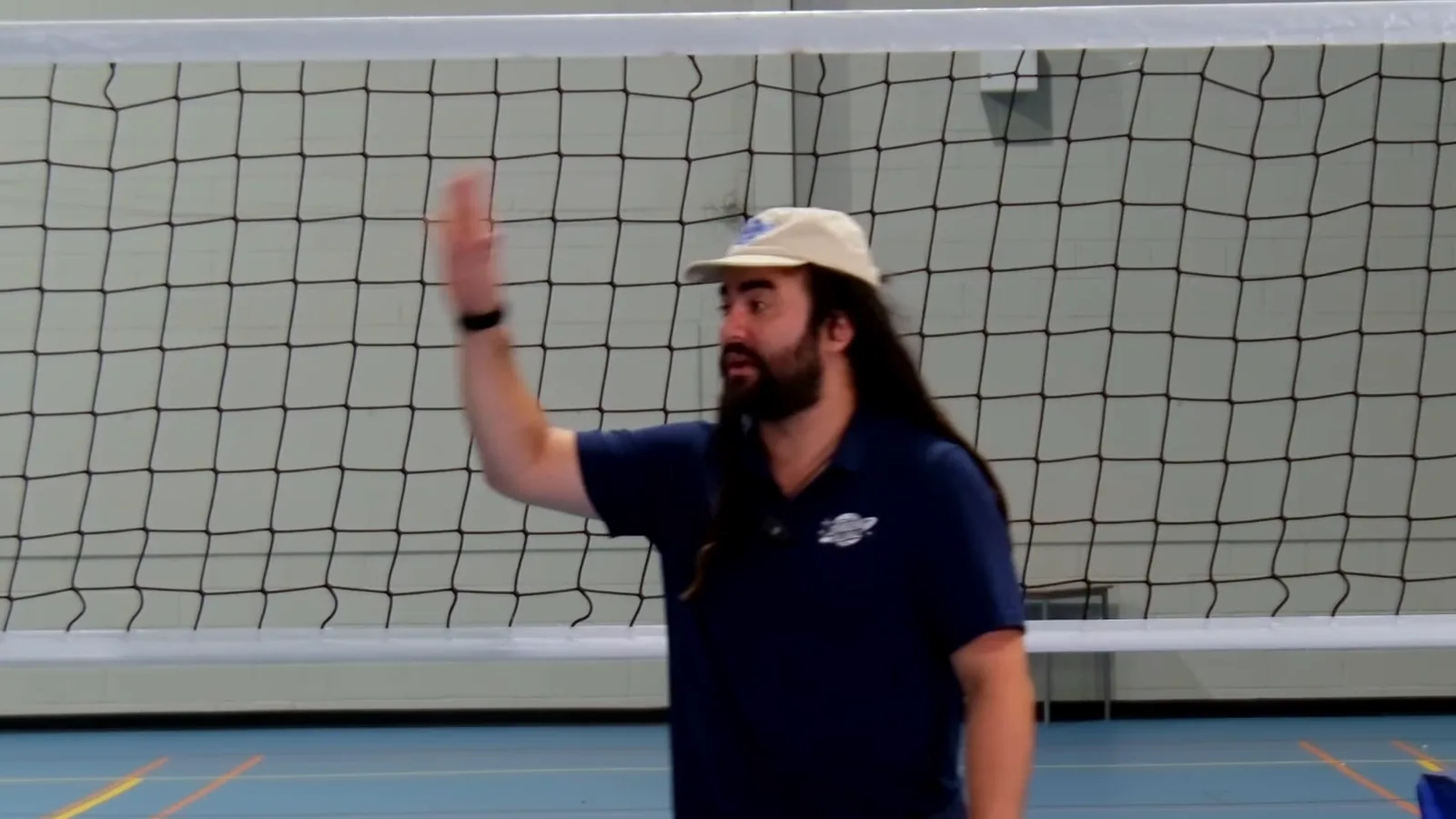
One job for you: watch whoever keeps sneaking in low fives. Usually that's the player whose energy is dropping hardest. Get them a high ten. And when someone brings energy to you, reciprocate.
How to prepare for a volleyball tournament week
Once you're at the venue, only two things can still be controlled better than every other team: food and sleep. You can't practice extra. So win the things you can win.
The prepare-week checklist
- Fuel: real meals, three times a day. More protein, more fibre.
- Top up smart: lollies are for right before or during a game, never an hour before. That's a spike, then a crash.
- Sleep: eight hours a night is the goal. Seven is the minimum.
- Digital hygiene: phone plugged in two metres from your bed, no screens for an hour before sleep. Half an hour is a fine start.
- Team life: keep shared spaces clean, and ask before you touch anything that isn't yours.
Food first. Fuel yourself like you're going to war. Your body is a fire, and food is the wood. Chips and lollies are paper and leaves. They burn fast and don't sustain you. You need heavy logs: high protein, high density food that keeps the fire going all day.
If you feel off, not reading the ball, not jumping high, I can almost guarantee it's what you ate. Don't be the teammate eating hot chips for breakfast, lunch and dinner.
Then sleep. If you recover 50% better than every other team, you win more games. Your thinking gets sharper, and your movement gets more explosive.
Aim for eight hours. Seven is the minimum. Sleep isn't just recovery, it's learning. More sleep means more REM sleep, and that's where your day gets sorted and stored. Sleep is how the lessons stick.
Don't panic if it's hard. Everyone wants to talk all night. Do your best, keep the phone out of your bed, and the rest takes care of itself.
Living with the team is a skill too
When you travel for a tournament, you don't get alone time. No door to close, no quiet recharge, just team time all the time. Great fun, until it isn't.
I need two things from you. Be chill, be reasonable. A team that starts the week pranking each other brings that energy onto the court, and by the end of the week you're chewing each other's heads off.
Second, be courteous. Whatever's on your bed is your bed, go wild there. But shared spaces belong to the whole team. Every mess you leave gets under someone's skin, and resentment is the silent killer of teams.
Get in the habit of asking. Ask for everything. Can I use your charger? Be annoying about it. Assumptions are the seeds to resentment, and 99% of the time your teammate says yes.
What to say after a loss
Nobody gets through a tournament without a loss. The question is what happens next, because that decides how tomorrow goes.
First: encourage failure. Do not punish failure. It goes for teammates, and it goes for you. The player who made the error already knows. They don't need the replay.
Second: the loss is information. It taught you something about your serve, your energy, your choices. That's value.
If a teammate is down, keep it simple:
That one's done. We don't take it home. Get some food, get some sleep, and tomorrow we go again. First point, high five, head high.
For a teammate after a tough loss
For the parents on the sideline
Parents, this part is yours.
You are not the coach this week. So talk less. The more you say, the less they hear, at every age group. Cheer loud, coach zero, and cheer the whole team.
After a loss, skip the review in the car. Ask one question: what's one thing you're taking into tomorrow? Then let them talk, or let them sit quiet. The car ride home is part of their recovery, same as food and sleep.
And help with the boring logistics, because they're quietly powerful. Get them to the venue early, so the hour of warm-up actually happens. Keep real food in the car. Guard the bedtime, and don't add sleep stress: that panic is worse than five minutes less sleep.
You've done your job when the tournament feels like a safe place to go and be brave.
Watch the full breakdown on my YouTube channel: How to thrive at big competitions.
Train for your next tournament with Coach Artie
Everything here is buildable. Practise it all tournament and it becomes who you are. Want to sharpen the skills before the big week? Start here: one tip for every skill in the game.
Skybound Volleyball trains at Macgregor State High School, capped at 16 players. See the schedule on the programs page or register on the Skybound portal.
You get better with your practice. So go practice being the best possible teammate you can be. Good luck in your competition.